Re: Letter on the Present: Time Since Then, and Now

In this digital residency in collaboration with Érudit, writer and researcher Hanss Lujan Torres explores how time has been experienced and discussed in contemporary art. In responding to an earlier contemplation on the present, written over ten years ago, he employs letter writing as a temporal practice and form of time travel, tracing the evolving discourses on time throughout Esse magazine’s archives.
Montréal, July 17, 2025
Dear Marie-Eve,
What strange and funny timing. During my digital residency, for which I proposed to explore how time is discussed in contemporary art, I came across your article, “Letter on the Present,” written for Esse’s thirtieth anniversary in 2014. I was pleased, but not surprised, to see writers contending with time’s shifting textures, anxieties, and the persistent intensity of the “now.”
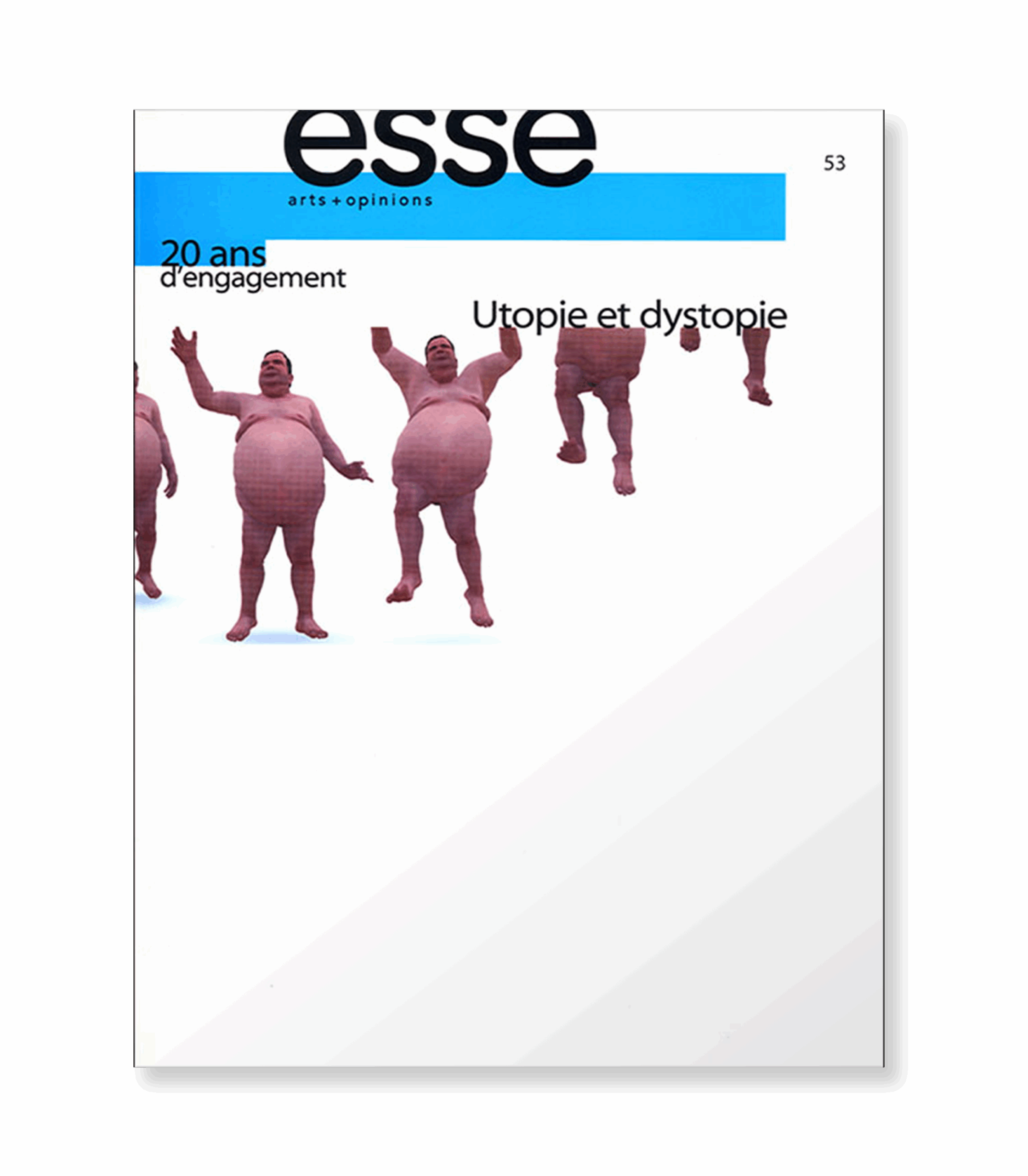
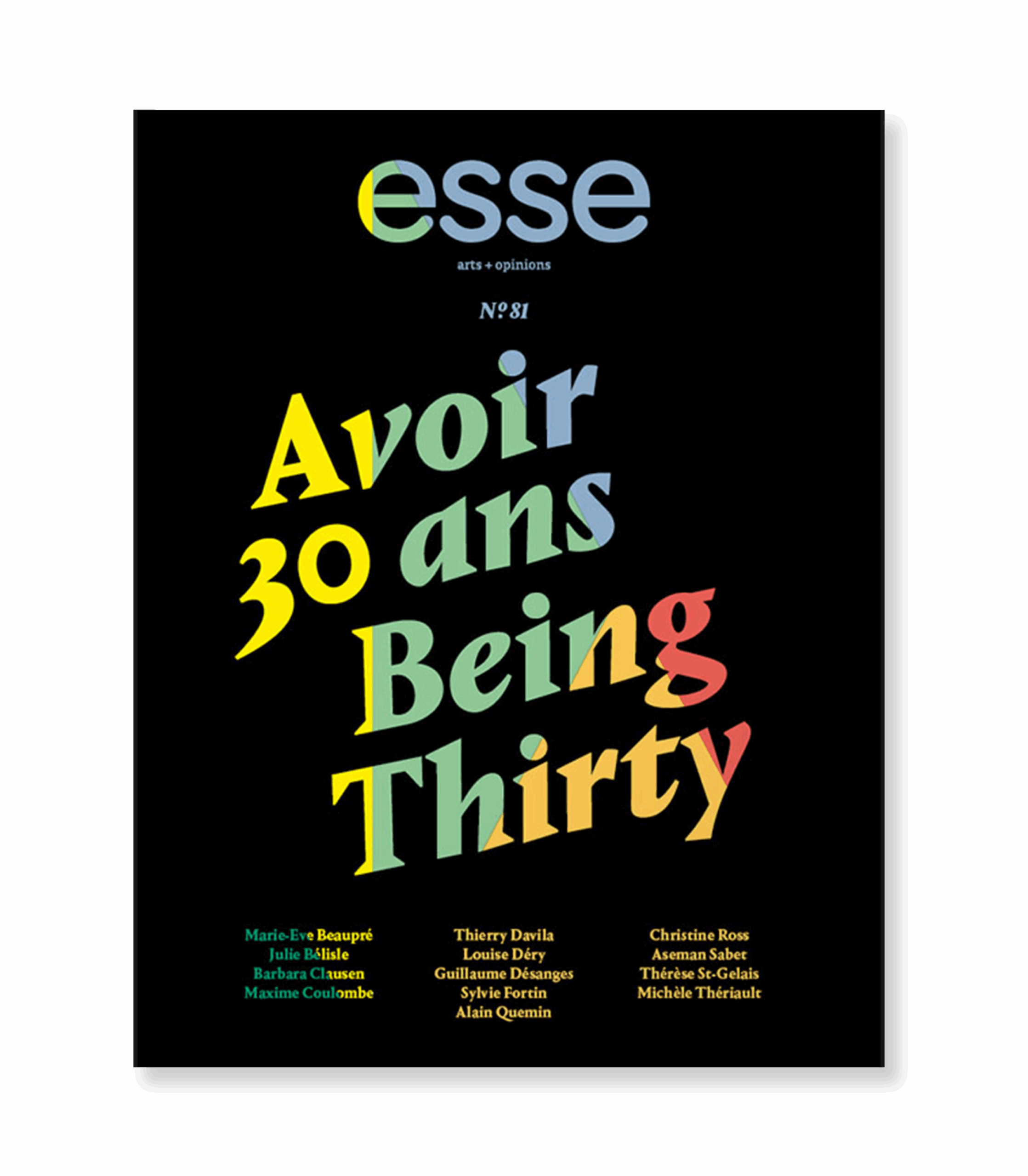
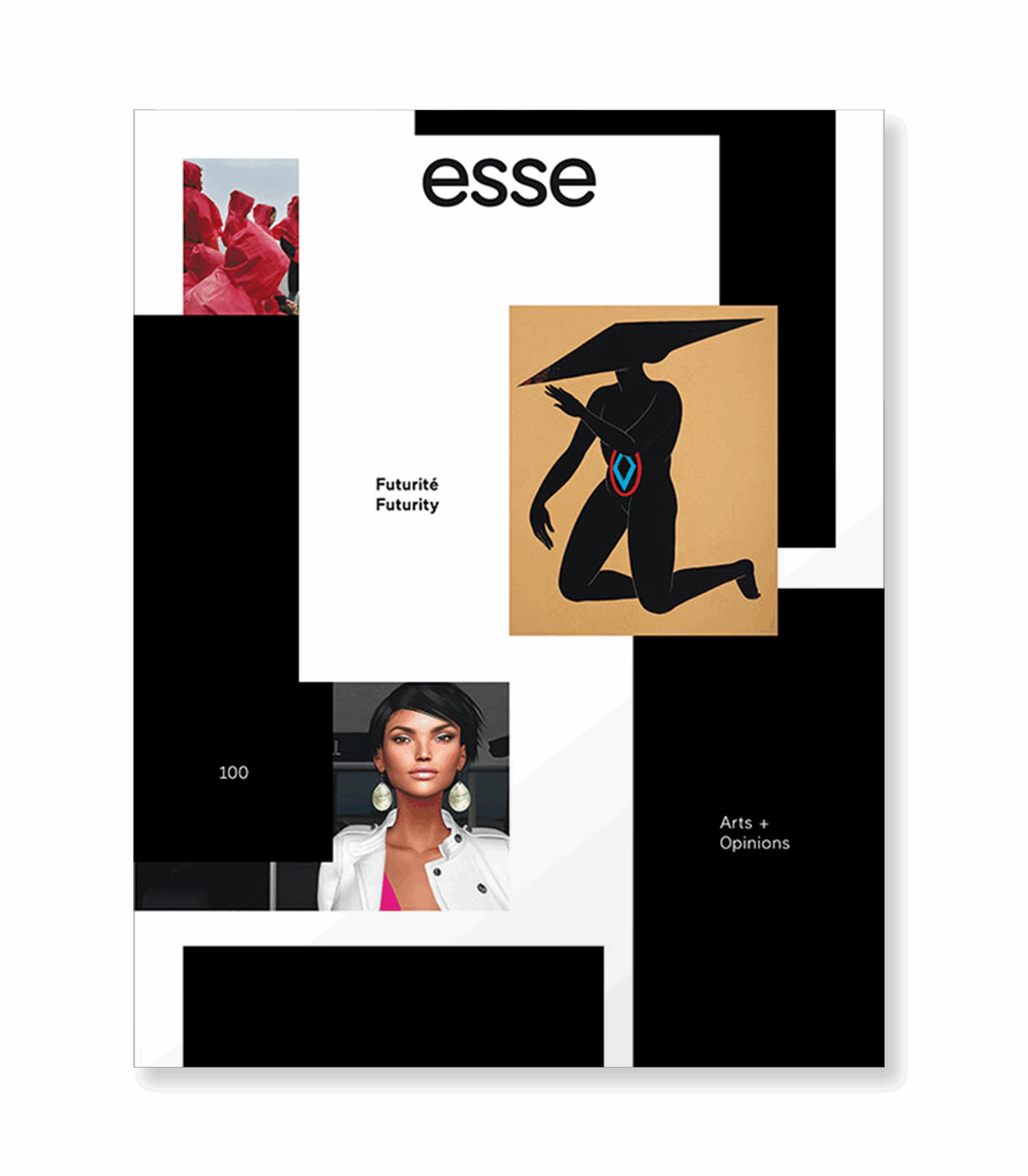
While browsing Esse’s archives, I noticed how reflections on time surface during moments of commemoration and retrospection. Your letter and other articles in the Being Thirty issue grappled with a digitally accelerating present, just as ten years earlier, the Utopie et dystopie issue, marking the magazine’s twentieth anniversary, was also interrogating the feeling of time, but through the hopes and anxieties surrounding the imagined futures of the early 2000s. By the hundredth issue, aptly themed Futurity, those envisioned futures had arrived. Time, it seems, folds inward with each milestone.
Those publications captured distinct perspectives on how the present was being felt, imagined, and understood in its moment. I am compelled to inform you that since you wrote your letter, time has collapsed at least once—perhaps more than once, depending on who you ask—and the world has shifted in ways that continue to reshape our relationship with it. Conversations on temporality in contemporary art have expanded inwardly, globally, and existentially. It is probably no coincidence that Esse turned forty years old last year. Perhaps now is an opportune moment for an update.
On Letter Writing
I am inspired by your approach to thinking about time in the form of a letter. Reading it more than a decade after it was written is a temporal experience that collapses time and bridges distance. Letters are gathering spaces to exchange ideas or, in this case, to meet. (Hi!) They can hold multiple moments at once, allowing us to experience the passage of time from distinct and shifting perspectives.
During this residency, I encountered an article in Érudit’s archives by a group of geography scholars who considered all the temporal dimensions of letter writing. In the journal ACME’s special issue titled “Desirable Futures,” its editors, Mabel Gergan, Pallavi Gupta, Lara Lookabaugh, Caitlin McMillan, Sara Smith, and Pavithra Vasudevan, position epistolary practices as a form of time travel.1 1 - Mabel Gergan, Pallavi Gupta, Lara Lookabaugh, Caitilin McMillan, Sara Smith, and Pavithra Vasudevan, “Desirable Futures: Write Me a Letter,” ACME: An International Journal for Critical Geographies 23, no. 2 (2024): 91–106, accessible online. What I found most compelling, however, is their exploration of the decolonial and feminist potentials of the letter as a medium. They cite letter exchanges from historical and contemporary contexts, including those between Audre Lorde and Pat Parker, whose writings provided a space for care, solidarity, and resistance as Black lesbian feminists navigating complex political terrains. They also reference the more recent exchange between Robyn Maynard and Leanne Betasamosake Simpson, who wrote to one another during the COVID-19 pandemic as a way to think through Black and Indigenous futurities while reckoning with the growing racial, colonial, and ecological crises of 2020. At its core, these exchanges foreground relational knowledge and show how writing across time can be a form of critical and collective world-building.

I recently saw an Instagram reel referencing James Baldwin’s 1971 letter to Angela Davis, in which he wrote, in response to her arrest, “If they take you in the morning, they’ll be coming for us that night.”2 2 - YK Hong (@ykreborn), “Always be ready already. Interdependence to collective liberation…,” video, April 18, 2025, Instagram, https://www.instagram.com/p/DIlh5h0O30F/; James Baldwin, “An Open Letter to My Sister, Miss Angela Davis,” The New York Review of Books, January 7, 1971, accessible online. Baldwin’s words, rooted in 1970s political struggles, resonate loudly today. Gentle yet forceful, letters are soft archives preserving thoughts and feelings that carry a latent power to rupture the present with echoes from the past. Coming across this letter via Instagram, of all places, also reminded me how letters have a way of finding us—just as I found yours or, perhaps, how it found me. All this makes a letter exchange feel like the ideal space to explore our tangled relationship with time and the present.
The Present, Then and Now
I was struck by your analysis of how thirty-something artists experienced time in 2014. Your observations on the pressures of modernity and the accelerations of technology and communication still resonate. But I must admit that today, the idea of being a “thirty-something” feels more ambiguous. I understand it as a generational timeframe tied to broader normative life-stage expectations. Artistically, it often signals a shift beyond training years and the “emerging” or “young” categories. Yet, amid ongoing economic precarity and institutional instability, milestones such as home ownership, parenthood, and a “successful” career feel not just delayed but impossible or simply no longer relevant for some of us. I imagine that the artists you wrote about have aged from that frame, but I suspect some are still reeling from the temporal dislocations of the early pandemic, when time stalled and accelerated at once. It felt like living inside Patrick Bernatchez’s BW, which you referenced, in which a single revolution takes a thousand years. For some, lockdowns and missed celebrations arrested development; for others, those years stretched on endlessly.

Your letter introduced me to the work of the historian François Hartog and his concept of “presentism.”3 3 - Marie-Eve Beaupré, “Letter on the Present,” trans. Ron Ross, Esse arts + opinions, March 11, 2014, accessible online. This idea of the dominance of the present over both the past and the future makes sense as a Western cultural condition for the 2010s, a decade during which accelerated communication technologies reshaped our temporal experience, compressing historical time into anever-intensifying now. Today, this feels even more acute—heavier, even—with the growing presence of artificial intelligence and the pervasive influence of social media and algorithmic systems. This hyper-present time privileges speed, immediacy, and simultaneity. It is relentless and overwhelming.
That may be why we gravitate toward art. It offers a way to make sense of the oversaturation of the present. Your observations on how artists embrace slowness, monotony, and contemplation provide a helpful lens for thinking about how art contends with the now. Interestingly, another article in the Being Thirty issue also references Hartog and presentism, complicating it in relation to contemporary art. In “Historical Time Ecologized,” Christine Ross agrees that modernity and presentism have altered our relationship with time. However, she argues that contemporary art does more than merely reflect presentism. “Privileging the present” in this context does not always come at the expense of the past or the future; instead, it can serve as a critical platform for building new temporal imaginaries.4 4 - Christine Ross, “Historical Time Ecologized,” trans. Käthe Roth, Esse arts + opinions, March 11, 2014, Ross references works by Marjetica Portč, Francis Alÿs, Pierre Hughe, and David Altmejd that circulate on ecologically grounded and durational forms of time to resist the accelerations of modernity.

Ross’s argument feels prescient, and it seems that Hartog has since come around. In a 2022 interview discussing the COVID-19 pandemic through the lens of presentism, Hartog noted how this crisis underscored an already growing awareness of humanity’s relationship with nature. He said, “We have reduced dramatically the earth’s biodiversity. What is completely new today is that humanity has become a geological force unto itself. This is what’s meant by the Anthropocene … It puts our whole view of the modern world—our vision of progress, our mastery over nature—in doubt.”5 5 - Hartog quoted in Bernhard Warner, “Work from Home Is Distorting Our Sense of Time—and It’s Still March,” interview with François Hartog, Fortune, July 12, 2020, accessible online. It’s a notable yet limited shift. Although Hartog gestures toward ecological urgency, the Anthropocene framework universalizes responsibility and obscures the uneven, ongoing colonial, racial, and capitalist forces that feed this overbearing presentism.
I don’t want to dismiss presentism entirely—I see it as a helpful framework for understanding the societal dynamics and feelings of time. I also do not wish to disregard ecological approaches to time, as these are vital and omnipresent, but I think that to truly address the feelings of the contemporary moment, we need this framework to engage with the politics of now. Presentism signals a loss of historicity, so rather than confronting it with another broad meta-narrative such as the Anthropocene, a more effective approach is to attend to micro-histories and localized experiences grounded in the present.
To speak of time—its structures and textures—we must begin with the personal. And the personal, as we know, is political. Time is political.
The Now, Now
Over the past year, I have noticed a growing number of exhibitions centred around videos that contemplate the experience of time. I must admit that when browsing through galleries, I have the bad habit of passing by video works, telling myself that I’ll return when time allows, although it rarely does. Lately, I have found myself slowing down for them, drawn in by the ways they hold time. Two recent exhibitions stand out as powerful examples of how artists grapple with the urgencies of the present while revealing the layered, often fraught nature of time. They remind us that the present is anything but flat, and that time is never neutral. In her 2024 solo exhibition A Temporary Loss of Consciousness at Galerie Eli Kerr, Joyce Joumaa used time-based media and the metaphor of Earth’s orbit around the sun to depict Lebanon’s ongoing power shortages. The title holds an interesting double meaning, referring both to electrical blackouts and to the personal experience of disorientation, delay, and temporal suspension. It builds uncertainty and intimacy. In her six-channel video Mutable Cycles II, displayed on screens resembling a solar panel, Joumaa examines the use of solar energy in the city of Tripoli amidst the current and ongoing socio-political and economic crises. Intermittent and meditative recordings of domestic rooftop scenes are layered with news coverage of the 2021 protests that erupted following the country’s massive blackout, forming a dialogue between electrical power and collective people power. Circling this work were five circuit-breaker boxes repurposed as photo lightboxes, illuminated for a sanctioned amount of time that corresponded to the electricity schedules of the depicted buildings. I was struck by how Joumaa underscored the precarity and fragility of time by framing quotidian moments in mundane objects. The material infrastructure becomes a way to trace personal and collective experiences of disruption, and the images present these seemingly trivial instances of light as profoundly precious. In her review of the exhibition, Irem Karaasian emphasizes how time was felt within the exhibition: “We inevitably succumbed to an overwhelming sense of frustration, a phase marked by ethical lapses in which we acquiesced and resigned ourselves to the prevailing circumstances presented in the works.”6 6 - Irem Karaaslan, “Joyce Joumaa: A Temporary Loss of Consciousness,” Esse arts + opinions, November 9, 2024, accessible online. I suspect that these feelings arose from the unsettling experience of encountering historical time within the present moment.

Mutable Cycles II, installation view, Galerie Eli Kerr, Montréal, 2024.
Photo: Simon S. Belleau, courtesy of the artist
Returning to your point about technology and communications intensifying our sense of time, I argue that social media has further altered how we perceive the now.We are hyper-aware of our present and exposed to that of others, near and far, and in real and short time: world events are synthesized into short clips, consumed with a scroll or a swipe. We now witness atrocities through our phone screens and are expected to carry on with the routine of daily life.
The 2024 exhibition P is for Palestine, curated by Ariane de Bois and Muhammad Nour ElKhairy at Plein sud art actuel, offered a sustained contemplation on the present and a space to slow down. In her review, Dominique Sirous-Rouleau observes how the exhibition “requires a considerable amount of time to immerse oneself in each proposal” and that “the poignant works recount what the media discourse neglects because they require time: life.”7 7 - Dominique Sirois-Rouleau, “P pour Palestine,” Esse arts + opinions, Winter 2025, accessible online (our translation). One video work, ElKhairy’s I Would Like to Visit, unfolds like a letter typed in real time. It begins with the phrase “I would like to visit Israel” which is gradually revised and reframed by the limitations that the artist faces as a Palestinian. The text drifts through potential futures fractured or foreclosed by colonial and political structures. His personal desire is suspended as linear progress is rendered futile.Colonialism has ravaged the past, leaving Palestinians caught in an unresolved and ceaseless present.

I would like to visit, 2017, installation view, Plein Sud, centre d’exposition en art actuel, Longueuil, 2024.
Photo: Guy L’Heureux
There is an interesting dialogue between ElKhairy’s video and the first work encountered in the exhibition, the 1988 video Measures of Distance by Mona Hatoum. The video features Hatoum reading letters her mother wrote to her during times of war and exile. Fragmented photographs that she took of her mother in the nude are slowly revealed and overlaid with her mother’s handwritten correspondence in Arabic. Here, distance is physical and temporal, measured in absences, delays, and the borders between them. The letters move seamlessly between past recollections and present emotions; domestic life and civil war are not separate but entangled, revealing how personal memory and political history inform and distort one another. Measures of Distance reaches across time, forming a dialogue with the present, in which dispossession and geopolitical forces persist.
In Conclusion
In your letter, you asked, “When shall we see a ‘Department of Time and Tempo,’ as Paul Virilio proposed?”8 8 - Beaupré, “Letter on the present.” It is a speculative idea, but one that feels increasingly necessary in an era defined by acceleration and exhaustion. I imagine that such a department, as Virilio suggests, would intervene in the accelerating logics of modern life, cultivating temporal literacy and protecting forms of slowness, care, and delay. I argue that artists already enact this role through their critical engagement with time, not just as material, but as a political condition shaped by power, history, and perception. Through their practices, they develop strategies that counter acceleration, sustain attention, and offer care and attunement to alternative temporalities.
In 2022, Hartog commented on the politics of the present: “In this kind of politics, it’s all about, first, reaction, and then emotion. And, of course, you have no space for any kind of reflection or analysis.”9 9 - Hartog, quoted in Warner, “Work from Home.” What he overlooks is art’s capacity to intervene. As we have been discussing, contemporary art makes the fragility of time visible. It can reconnect the present with the past and resist linear promises of progress. It can also open space for slower, more contemplative experiences of time. To quote Nina Simone, “An artist’s duty … is to reflect the times.”10 10 - Nina Simone, interview excerpt, Nina Simone on the Role of an Artist, 1968, video, 1:46, posted by “NinaSimoneMusic,” February 26, 2013, YouTube, accessible online. I think a lot about her phrasing the times in the plural as a deliberate way to emphasize a layered reality for reflection, pointing back at the present, yes, but also across its multiple registers. We, as writers, can do our part by offering analyses that fracture the dominanceof the oversaturated present as time continues to unfold.
With care,
Across the fold, Hanss
Links to the articles cited: Marie-Eve Beaupré Mabel Gergan, Pallavi Gupta, Lara Lookabaugh, Caitilin McMillan, Sara Smith et Pavithra Vasudevan Christine Ross
Hanss Lujan Torres is a curator, researcher, writer, and arts worker from Cusco, Peru, currently based in Tiohtiá:ke/Mooniyang/Montréal. In his research and writing, he considers subjugated archives and queer temporalities in order to imagine alternative futures in contemporary art. He holds an MA in art history from Concordia University and a BFA in visual arts, with a minor in art history and visual culture, from the University of British Columbia Okanagan. Lujan Torres has previously contributed to Esse arts + opinions. He is the research coordinator for the Indigenous Futures Research Centre.


