Performance for the Camera: Queerer than the Sum of its Parts

During their digital residency produced in partnership with Art Volt, naveed L. salek nejad went on an “anal tour” through Esse’s archives in search of Canadian trans and gender-non-conforming artists who enact their identities through performances for the camera, a hybrid medium that offers a subversive strategy for realizing gender beyond the binary.
The entrance to the The Inverted Museum (2020) at the 11th Berlin Biennale was quite intriguing: through the back door. The mediation team embraced the theme by organizing the campiest activity possible, titled The Anal Tour. More than entering through the back, the two guides provided an “elegantly bitchy conversational counter-narrative tour,” deconstructing central norms in the process. “What makes an artwork queer? How can we experience art from a trans-feminist perspective?”1 1 - “Focus Tour: The Anal Tour,” 11th Berlin Biennale, accessible online.
Entering through the back door takes away any straightforward approach to meaning-making. We begin to question our expectations and, thus, which norms dictate how we relate to and interpret art, shaping which histories are deemed canonical and memorable. These norms, like the rest of mainstream society, are mostly hetero-temporal; linear, predetermined, and gendered. Why can’t one laugh out loud? Why are so many exhibitions designed according to the logic of the average life of a heterosexual married couple? Why aren’t narratives more like our intestines: dark, symbiotic, slippery-when-wet, meandering, a source of ecstatic pleasure, and “queerly decadent?”2 2 - Julia Skelly, “Queer Decadence and Decadent Ecologies in Laurence Philomène’s Photography,” Esse arts + opinions, no. 106 (2022), p. 82-85, accessible online.
The Anal Tour’s ingenuity slipped my mind for many years, but it came right back during a recent lecture by the art historian Erin Silver titled “Writing, Making, and Transmitting Queer Canadian Art Histories.” While I was struck by the extent of the ongoing marginalization of queer narratives within Canadian art history, there was also an opening to engage archival work on queer art practices by crawling backwards in time. As academics and cultural workers, we mustn’t only reclaim 2SLGBTQ+ narratives, which have been “hiding in plain sight” for decades, but also preserve them so that their fruits will last for generations to come. For me, this means furthering the representation of trans and gender-non-conforming (GNC) narratives in contemporary art writing at the intersection of performance,3 3 - I use a broad definition of performance as any body-based art. lens-based media, and gender identity.
Working my way backwards through Esse’s archives, I researched how trans and GNC artists enact their gender identities through performances for the camera. On this subsequent “anal tour,” I return to articles by Anne-Marie Dubois, Nelson Henricks, Julia Skelly, and Julie Richard, who wrote, respectively, about works by the artists Cassils, Colin Campbell, Laurence Philomène, and Kama La Mackerel. It would be impossible to reduce these works to fixed documentations of an otherwise dynamic embodied movement. No, the relationship between queerness and the use of performances for the camera is symbiotic.
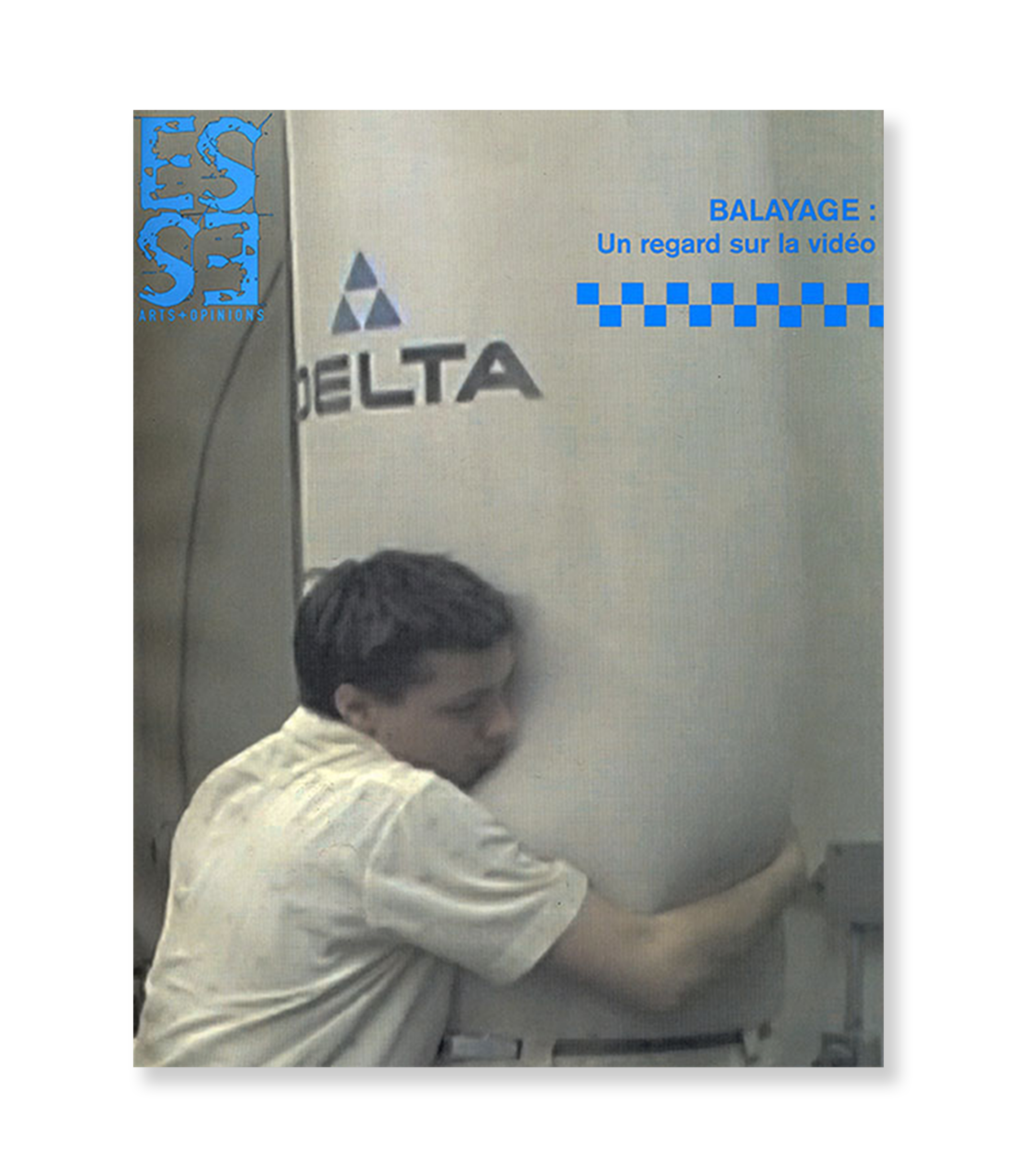
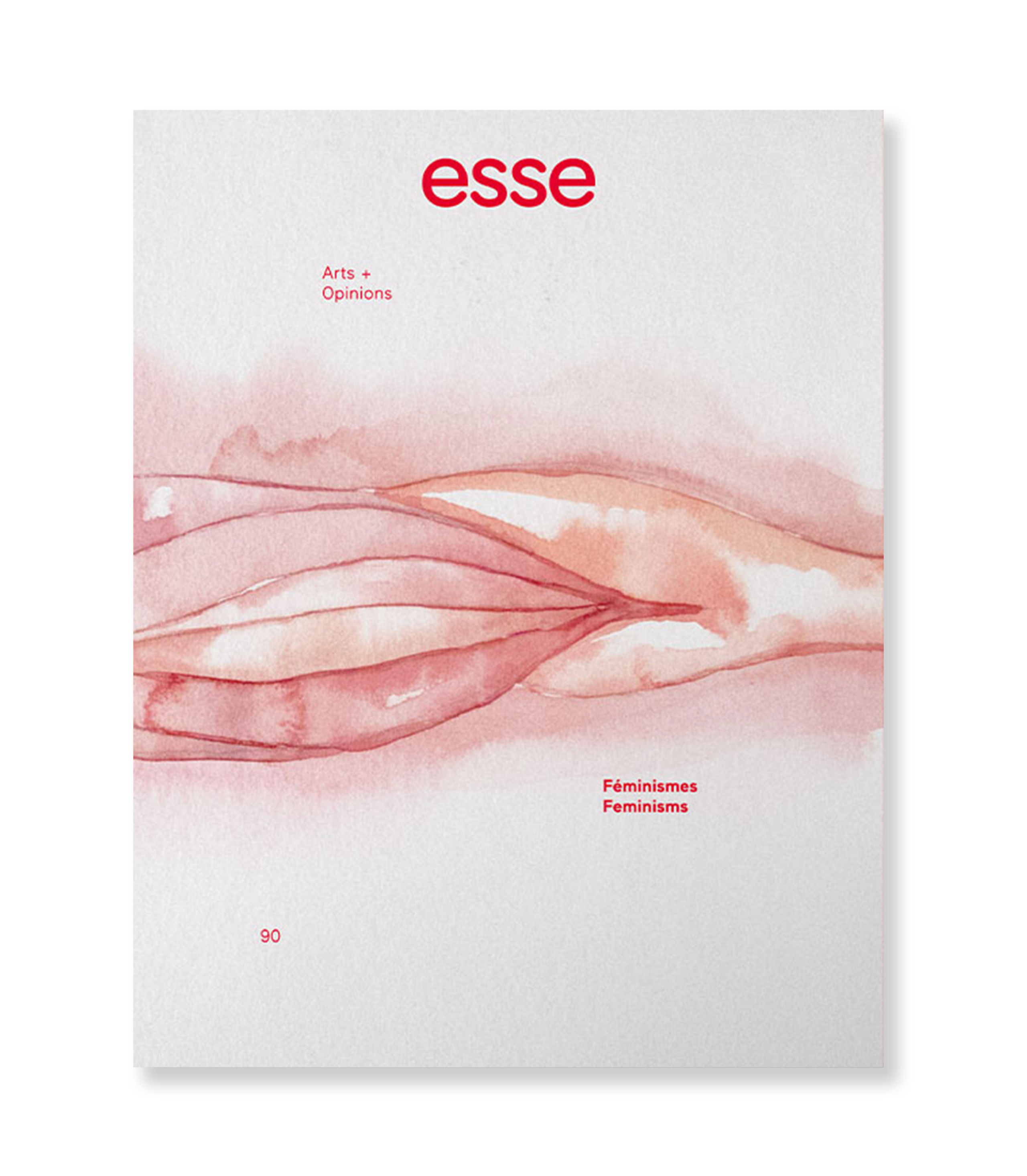
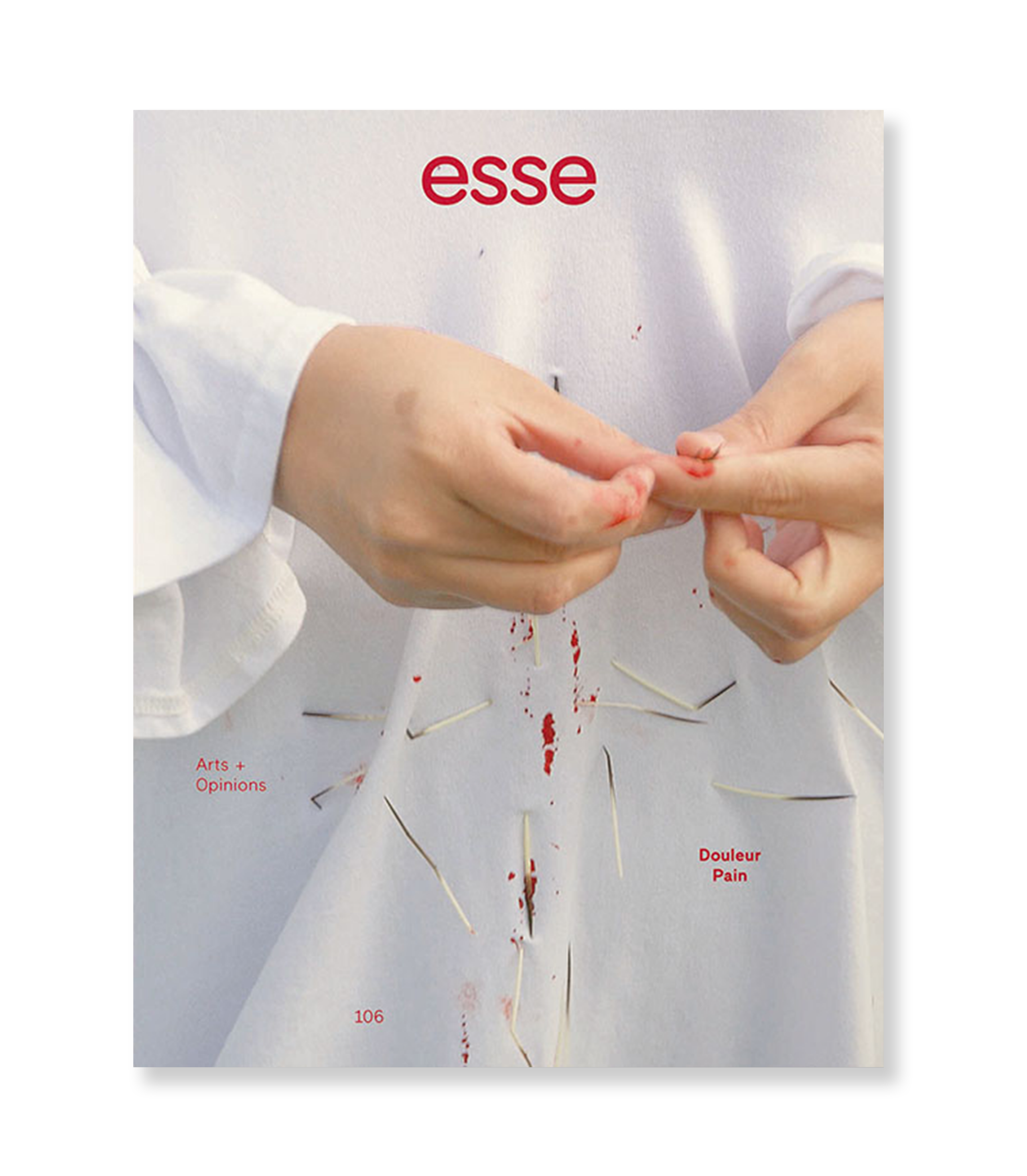
A Methodology of Un_Becoming
Too often, gender performativity is reductively understood as gender being a performance—a play that we put on. Instead, as the philosopher Paul B. Preciado suggests, “biocodes of gender” erratically and conventionally assign meaning in a male-female dichotomy. Then, gender is enacted through performative acts that signify rather than display gender. By making these biocodes disappear and appear at the same time, trans and GNC performance artists push signifiers of gender to the limits by using performances for the camera as a methodology of un_becoming.
Montréal-born performance artist Cassils, whose practice I first encountered in the touring exhibition Masculinities: Liberation through Photography (2020), best illustrates this. The group show featured Time Lapse (2011), photographs of Cassils’s half-year-long durational performance Cuts: A Traditional Sculpture (2011), the work at the centre of Dubois’s article “Of the Techno-Plasticity of the Body in Cassils.” Cuts: A Traditional Sculpture is a direct take on Eleanor Antin’s 1972 work, in which Antin crash-dieted for forty-five days to carve her body’s mass. However, whereas Cassils followed an equally stringent dietary regime, including steroids, they actually aimed to increase rather than decrease their flesh as much as possible over the course of twenty-three weeks.

Time Lapse (Front, Back, Left, Right), details of the performance Cuts: A Traditional Sculpture, 2011.
Photos: courtesy of the artist & Ronald Feldman Fine Arts, New York

Indeed, I was fortunate to be able to co-produce the online programming for this exhibition, which included a lecture and Q&A with Cassils on their 2011 works. Their statement “I personally perform trans not as something about crossing from one sex to another, but rather as a continual process of becoming that embraces indeterminacy, spasm and slipperiness”4 4 - “Behind the Screen: Cassils,” Gropius Bau, last modified March 3, 2021, accessible online. best reflects my sentiment about the intersection of queerness and performances for the camera. Hence, the purpose of Cuts: A Traditional Sculpture isn’t to render Cassils a man but to expose and destabilize the biomechanics that constitute gender in the first place. The only constant is the inherent tension of the competing biocodes in the photographs: muscled arms and breasts, a jockstrap and lipstick, as we see in Cassils’s Advertisement: Homage to Benglis.
Dubois illuminates crucial differences between Cassils’s performances for the camera and those of Benglis and Antin, two cis-female performance artists. Although both of these artists extensively modified their bodies and used photography to document the process, Dubois emphasizes that their performances for the camera serve different functions. Whereas Antin aimed to denounce her gendered reality as a cis-woman, Dubois writes, “Cassils seeks to reverse the relationships of objectivization and instrumentalization of the female body by producing a body that is in fact hyper-masculine.” And thus, Cassils reclaims the biocodes that assign bodies “a natural status” in the first place.5 5 - Anne-Marie Dubois, “Of the Techno-Plasticity of the Body in Cassils,” trans. Ron Ross, Esse arts + opinions, no. 90 (2017), p. 44-51, accessible online.

Advertisement: Homage to Benglis, 2011.
Photo: Cassils & Robin Black, courtesy of the artist & Ronald Feldman Fine Arts, New York
Trans_gressive from Its Inception
This comparison of Cassils’s and Antin’s works doesn’t mean that performances for the camera are a methodology that has been reclaimed from cis-female artists or that I am retroactively framing performances for the camera as queer. In fact, the use of lens-based media in performance or vice-versa was pioneered in the 1970s in so-called Canada by GNC artists who were contemporaries of, rather than successors to, Antin and Benglis.
Following Colin Campbell’s death in 2001, Henricks wrote a deeply personal, poignant meditation on Campbell, “True Lies: The Importance of Being Colin,”6 6 - Nelson Henricks, “Les vrais mensonges ou de l’importance d’être Colin,” trans. Isabelle Chagnon, Esse arts + opinions, no. 46 (2002), accessible online. The English-language original of this text, “True Lies or the Importance of Being Colin,” can be found at nelsonhenricks.com/wordpress/wp-content/uploads/2014/09/True_Lies.pdf. honouring his ground-breaking contribution to video art. Campbell, who in fact “saw himself as bisexual and bigendered,” produced over fifty videos from 1972 onward.7 7 - Kathleen Mullen, “A truly queer network: Video artist Colin Campbell & Toronto’s fruitful art scene,” Xtra, last modified December 31, 2008, accessible online. At that time, this new medium lurked at the art world’s periphery, and Campbell was one of the first Canadian artists to adopt it.
Like many of his contemporaries, Campbell was alone in front of the camera. Here lies the crux: Campbell’s personas appear rounded “in an almost mediumistic manner” because of their inseparability from the artist himself.8 8 - Nelson Henricks, “True Lies or the Importance of Being Colin,” nelsonhenricks.com/wordpress/wp-content/uploads/2014/09/True_Lies.pdf. Additionally, his personas transgressed gender’s significance due to his æffective use of cross-dressing9 9 - I coined this term, meaning both “affective” and “effective.”—which, as Henricks notes, was out of necessity rather than a dramatic je-ne-sais-quoi.
Campbell refuses to respond to the viewer’s mental shortcut regarding the stability of gender by giving only a taste of the feminine, but never excluding the masculine either.
I wasn’t familiar with Campbell’s practice before diving into the archive, but finding out about him in Henricks’s text felt like hitting the jackpot. Although Campbell is conventionally known as a video artist, I was struck by Henricks’s discussion of the corporeal nature of his videos, any analysis of which would feel incomplete without acknowledging the embodied nature that extends beyond the narrative frame. What truly distinguishes Campbell’s video works is how perceptibly his embodiment manifests within them.
Both queerness and performances for the camera break meanings into multitudes like a prism breaking light into a full spectrum. Although we might associate the camera with connotations of stability or fixedness, I argue that performances for the camera confront the viewer with multiple paradoxes not only in Campbell’s practice but also in those of the following two artists, who erode not only the gender binary but essentialist concepts of identity and nature altogether.
From Queer Decadence to Decolonial Ecologies
Just as the Huldufólk—mythical, invisible elves—survive Iceland’s harsh climate and landscape, so does Laurence Philomène in their eponymous 2019 self-portrait series. A tattooed, naked body drapes a solid rock. What looks ethereal and tender to us must have been a strenuous physical exercise for the Philomène, who is the subject of Skelly’s 2022 article. Through the concept of queer decadence, “a deliberate femme queering of an aesthetics and a late nineteenth-century discourse,”10 10 - Skelly, “Queer Decadence.” Skelly invites us to view Philomène’s photography practice as an anti-patriarchal reflection on the boundaries between humans and nature.
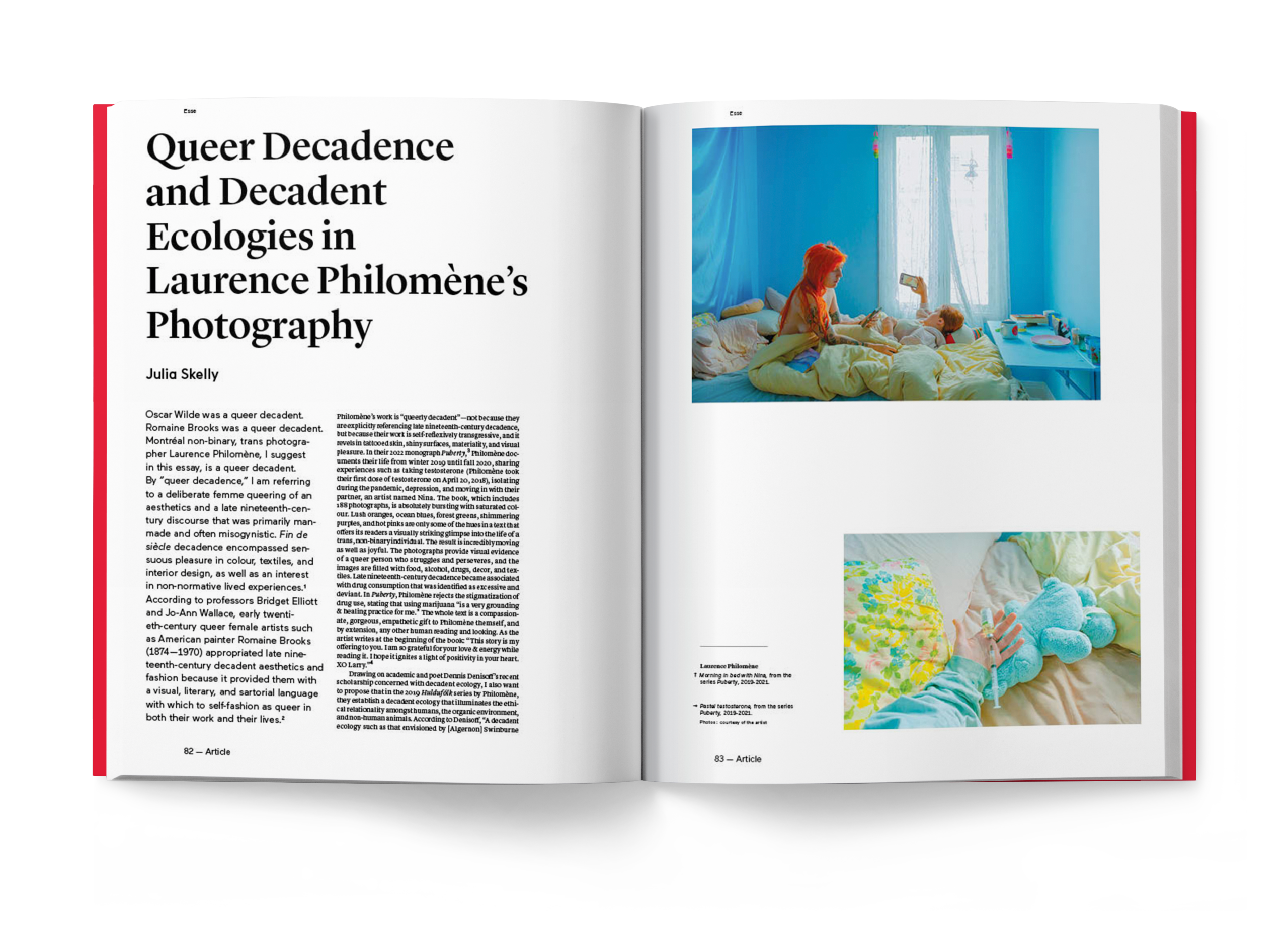
The grass on the edges looks dead—indicating a cold season—and the mud-covered feet must have stemmed from walking in the freezing brook. And yet, we have the feeling that Philomène experiences the pleasure of dissolving into the water and the land, as if there were no difference between the orange of the lichen and the orange of their hair. And at the same time, even as they seem to flow away, their body grabs our attention, becomes its focal point, defying the contrast with the landscape.
As in Cassils’s work, struggle and perseverance, tension and tenderness, human and nature, lead to an embodied reflection of the self so transgressive and decadent that no dichotomies can withstand it. The transitions from invisibility to visibility, from performance to photography, are effortlessly fluid in Philomène’s works. They present us with a whole that can be reduced neither to themself nor to Icelandic nature—a whole that is queerer than the sum of its parts.

Lava Field, from the series Huldufólk, 2019.
Photo: courtesy of the artist

Orange Lichen, from the series Huldufólk, 2019.
Photo: courtesy of the artist
Yet caution is called for when thinking about landscape. The vastness of landscapes can sometimes be mistaken for emptiness or wildness, an understanding that fed the infamous colonial concept of terra nullius, “no man’s land.” In her review of La Mackerel’s exhibition Who sings the queer island body? (2023), the art historian and critic Julie Richard not only dissects this concept but also illustrates how La Mackerel’s multidisciplinary practice challenges its colonial legacy in their native island of Mauritius.11 11 - Julie Richard, “Kama La Mackerel Who sings the queer island body?,” Esse arts + opinions, 2023, accessible online.
In the exhibition Basalt body 1 (2023), a series of nine large-format self-portraits, we see La Mackerel’s Black body sensually lying down in the littoral zone, seemingly merging with the basaltic rocks and black sand of the Mauritian coast. And in Banyan body 1 (2023), their pants make it seem like their legs are one with the aerial roots of the trees around them. As we witness La Mackerel’s spiritual dialogue with the forces of Mauritian nature (and society), Richard recognizes the central role that their trans body plays in the creation of their lens-based works. As they come face to face with the land and ocean, as we see the sun reflected on their body, La Mackerel is vulnerable yet graceful. For in these performed rituals, we witness not only their self-actualization as a Zom-Fam, “meaning “man-woman” or “transgender” in Mauritian Creole,12 12 - La Mackerel, lamackerel.net/artistic-projets/zom-fam/. but also their enduring and sovereign presentation of a visual counter-narrative of Mauritius—a narrative at odds with the hetero-patriarchal legacy brought by European colonialism, which continues to be projected onto the island by the exoticizing, orientalizing gaze of Westerners.

Basalt body 1, 2023.
Photo: Ashvin Ramdin
La Mackerel is never swallowed by the scenery, never just an ephemeral presence on a supposedly empty land, because the decolonial power that their performances for the camera possess cannot be physically or mentally contained. And so, the transgressive and empowering nature of their works continues to flow beyond the shore of Mauritius to us, wherever we may read these words.
Beyond the Authority of the Lens … and Society
We see, in these works, that the act of recording is more than a static act of observation, a freezing in time of an ephemeral motion. Far from that, the videos or photographs become imbued with the corporeality of the trans and GNC artists through their performance, which supersedes the power of lens-based capture. The on-the-spot symbiosis of the artist’s embodiment and the lens-based image allow the displayed personas to take on their almost spiritual or larger-than-life significance. As a hybrid medium, performances for the camera offer subversive and, most importantly, queerly decadent strategies for realizing identity “beyond the binary”—not only in terms of gender. But just as queerness evades binaries, so, too, are performances for the camera born out of a constant and inseparable tension between ephemerality and permanence, pain and pleasure, capture and evasion, becoming and dissolving, living and nonliving, hypervisible and invisible, authority and liberation.
Links to the articles cited: Anne-Marie Dubois Nelson Henricks Julia Skelly Julie Richard
naveed L. salek nejad is an artist-writer and cultural mediator. They holds an MA from Concordia University’s Individualized Program, having explored how a feminist ethics of care can act as a decolonial gesture in exhibition making. Their non-fiction writing and poetry has appeared in books published in Germany (Querverlag) and the United States (Thick Press), and in self-published artist’s books and zines. Born to a Polish mother and Irani father in Germany, they resides in Tiohtiá:ke/Montréal.


