Aesthetics and Politics: Can Pedagogy Be Saved?

In this essay, written as part of his digital residency in collaboration with Érudit, the author analyzes contemporary forms of the politicization of art in the early 21st century. He examines how the relationships between art, criticism, and political engagement are articulated today, particularly through a critique of the concept of the “aesthetic regime” as formulated by Jacques Rancière.
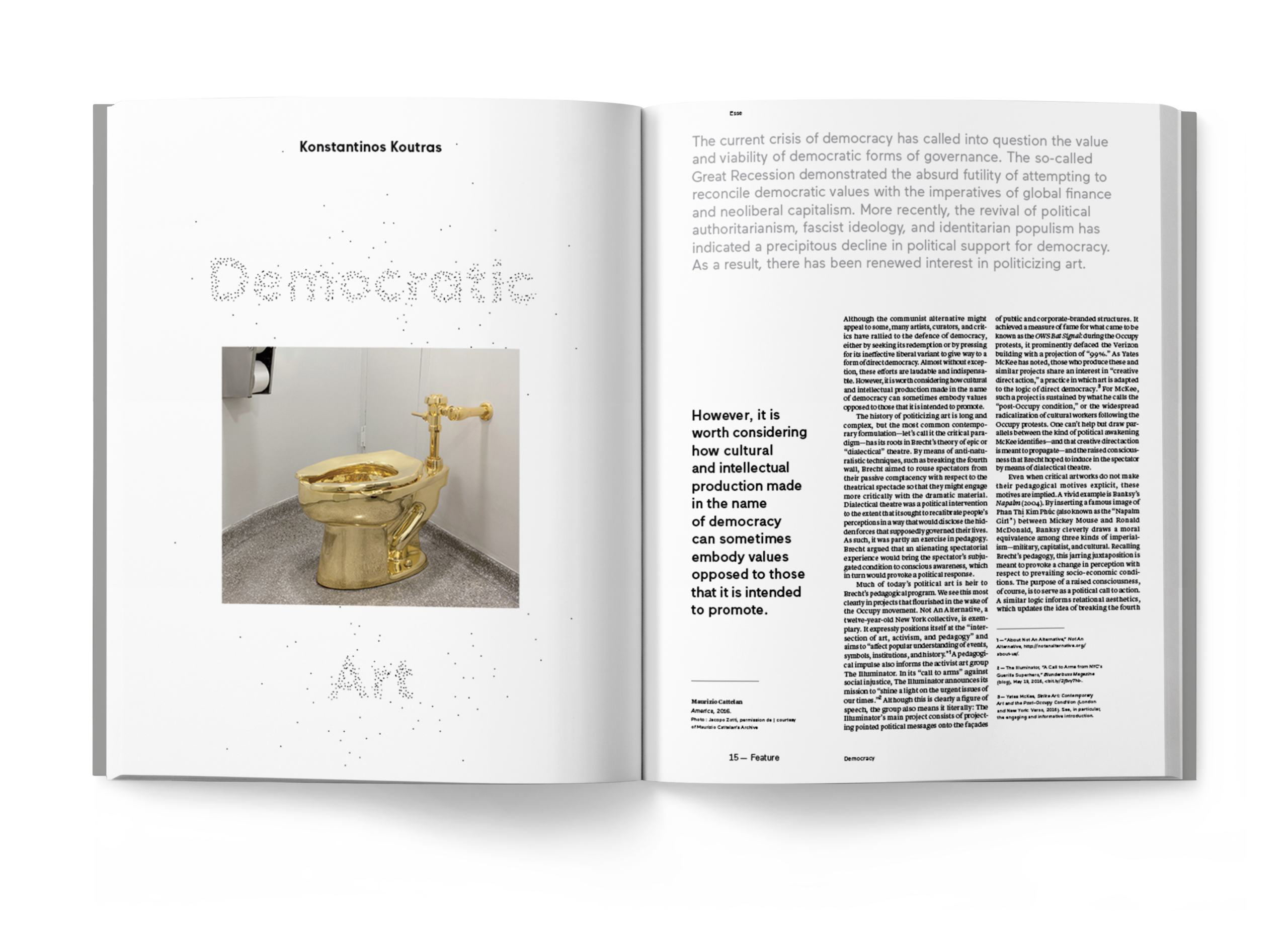
When Esse published its issue on democracy in 2018, I was just beginning to work on my doctoral dissertation on the contemporary issues of politicizing art.1 1 - Louis Boulet, “Enjeux politiques des expositions photographiques contemporaines en France: une étude du Jeu de Paume (2004–2020),” PhD dissertation, Université du Québec à Montréal, 2025, accessible online. I was very interested in the issue, therefore, and was particularly struck by Konstantinos Koutras’s article.2 2 - Konstantinos Koutras, “Democratic Art,” Esse 92 (Winter 2018): 14–18, accessible online. Here, I would like to return to contemporary forms of politicizing art and images in the early twenty-first century—a period during which, as Koutras emphasizes from the outset, there was a renewed interest in political art.
In this essay, I focus on regimes of contemporary political engagement, especially in Québec, in a body of work that spans the first two decades of the twenty-first century. As Koutras suggests in his article, I pay particular attention to the unique resonances of the French philosopher Jacques Rancière’s ideas in the archives made available by Esse and Érudit, and especially to the politicizing art regime that he advocates and that I will call the poetical regime. I will review the issues specific to this regime, which in general hinges on politicizing the art form itself, and then show its limitations and possible ways of surpassing them.


Over the years, Rancière has developed a particularly dense and cohesive reflection on art and politics whose influence is well established. According to the young researcher Umut Ungan, writing in the magazine Espace, he embodies the “philosophical endorsement”3 3 - Umut Ungan, “Pratiques du dissensus: notes sur l’esthétique conflictuelle,” Espace 125 (Spring–Summer 2020): 15, accessible online (our translation); see Oliver Marchart, Conflictual Aesthetics: Artistic Activism and the Public Sphere (Berlin: Sternberg Press, 2019), 13–14. of the implicit ideology widely shared in the art world today. This ideology exists to varying degrees in the body of work that I examine, whether or not it is explicitly associated with Rancière, and I can summarize it broadly in three points.
First, this regime is radically, and at times virulently, opposed to modernist politicization—that is, “an explicitly political art.”4 4 - Ungan, “Pratiques du dissensus,” 15 (our translation). This idea comes up in the work of the French philosopher Marie-José Mondzain, who, for example, describes photojournalism as “obscene” and denounces “the ambition to show everything,” which would be “dismally [trivial].”5 5 - Michaela Fiserova, “Image, sujet, pouvoir: entretien avec Marie-José Mondzain,” Sens public (2008): 17, accessible online (our translation). Similarly, in issue 51 of Esse, Aline Caillet criticizes the artistic social engagement, the certitudes, and the overbearing character of the avant-garde.
This rejection of modernist certainty leads to the second characteristic of the regime: a rejection of pedagogy, which Rancière often expresses through the metaphor of the “straight line” and identifies with “the logic of the stultifying pedagogue, the logic of straight, uniform transmission.”6 6 - Jacques Rancière, The Emancipated Spectator, trans. Gregory Elliott (London: Verso, 2009), 14. A trace of this is found in the writing of Caillet, who denounces the avant-garde’s naive belief in the “instant translatability between aesthetic experience and political action.”7 7 - Aline Caillet, “Figures de l’engagement, esthétique de la résistance,” Esse 51 (Spring–Summer 2004): accessible online (our translation). Such criticism of the pedagogy of art is Koutras’s main argument; he asserts, in a manner in keeping with Rancière’s writing, that pedagogical logic ends up perpetuating the inequality it is trying to abolish: “To the extent that it traffics in pedagogy, then, critical art is opposed to democracy.”8 8 - Koutras, “Democratic Art,” 16. This rejection of critical art is based on a radical idea of democracy developed as an “equality of intelligence”9 9 - Rancière, The Emancipated Spectator, 1. and a denunciation, recurrent in Rancière, of the link between cause and effect, intention and reception. In Rancière’s view, “democracy in literature” corresponds to “the equality of all subject matter,” to “the negation of any relationship of necessity between a determined form and a determined content.”10 10 - Jacques Rancière, The Politics of Aesthetics: The Distribution of the Sensible, trans. Gabriel Rockhill (London: Continuum International Publishing Group, 2004), 14.
This logically leads us to the third salient point of the poetical regime: the apologia for disconnection, which Caillet sums up as the capacity to “produce new arrangements”11 11 - Caillet, “Figures de l’engagement” (our translation). that can allow critical perception. Koutras also reaffirms that “other configurations of the sensible … are possible” and establishes Marcel Duchamp’s Fountain (1917) as the emblem of truly democratic art in that “it throws some of the very categories that constitute social reality … into question. It suspends the rules according to which we assign roles and identify spaces.”12 12 - Koutras, “Democratic Art,” 17. For her part, Mondzain defends the idea that the image itself constitutes an excess, as it eludes power and discourse; through its polysemy, the image allows whoever looks at it to have freedom. Following this logic, Sophie Ristelhueber’s work is given as an example, insofar as it makes one understand the situation in Iraq and Palestine without showing it. In radical contrast to photojournalism, the image can therefore plunge the gaze into crisis: “There is no knowledge in the image … For [Mondzain] this is its power and political destiny.”13 13 - Fiserova, “Image, sujet, pouvoir,” 3, 5 (our translation). These three authors express positions that, despite their differences, reflect a common regime in which art is the activity that can break through social conformity by establishing symbolic constructions that differ from daily life: “Art’s true politics resides in its complexity, obliqueness, and remoteness from any political practice in the strict sense.”14 14 - Oliver Marchart, Conflictual Aesthetics: Artistic Activism and the Public Sphere (Berlin: Sternberg Press, 2019), 12.
These positions are surprising, if not paradoxical. Indeed, the poetical regime discredits socially engaged practices at the same time as it describes those that are farthest away from it as political: “The common feeling of the art field is that art is truly political only when it is not.”15 15 - Ungan, “Pratiques du dissensus,” 15 (our translation). Similarly, the politicization of the works that I have briefly mentioned here is based on a rejection of representation, as Caillet makes explicit: “Describing does not mean fighting against, representing does not mean capturing, denouncing does not mean resisting, shouting at each other does not mean interacting.”16 16 - Caillet, “Figures de l’engagement” (our translation). In socially engaged art, which usually relies on representation and denunciation, even the aim of the engagement is altered: the point is to attain symbolic change, not “concrete political action.”17 17 - Ibid. (our translation). This reasoning has its limitations, however, such as its radical criticism of any teaching process, which it systematically conflates with propagandist subjugation. This is the criticism that Mondzain takes up with the idea of an instrumentalization, a mastery of the image that no longer allows viewers to “construct what it’s supposed to mean”18 18 - Fiserova, “Image, sujet, pouvoir,” 17 (our translation). for themselves. The fusion of education and propaganda is best expressed by Koutras when he denounces art that tells “the spectator what to do and how to think” and whose authors base themselves on “the dogmas of official policy.”19 19 - Koutras, “Democratic Art,” 17.
This argument, however, poses serious problems. First of all, a paradox haunts Koutras’s essay, as well as Rancière’s writing: How can one consider pedagogy as something that subjugates, that constantly reproduces the gap between knowledge and ignorance, when one is oneself writing a book to explain it, sometimes in an eminently overbearing manner?
Can one then assume that a straight transmission is possible and acceptable? Furthermore, we might ask what type of methodology would be able to determine whether or not an image is propagandist. For all that, pushing this regime to the limits of its logic leads to shocking conclusions: pedagogy becomes incompatible with democracy, as Koutras claims. Above all, can we so vehemently denounce photojournalism, which Mondzain deems “doing things any which way,”20 20 - Fiserova, “Image, sujet, pouvoir,” 17 (our translation). The situation in Palestine comes to mind, but unfortunately, the situation is global. when reporters are subject to extremely serious threats and when their democratic role seems more important than ever? The selection of artists defended by these authors as emblematic of political engagement can, moreover, be contested: must we really believe that Duchamp’s work has had more impact than that of any other critical artist? Given the work of artists who are deeply engaged in the social struggles of their time, the choice of Fountain as a model of political art looks like a provocation.21 21 - I’m thinking, for example, of Paolo Cirio’s work on state surveillance, for which he was persecuted. See Jean-Paul Fourmentraux, “La sous-veillance, Paolo Cirio,” Techniques & Culture 74 (October 2020): 148–49, accessible online.
Lastly, the analysis22 22 - Koutras, “Democratic Art,” 17. with which Koutras concludes his article seems problematic to me: he regards Banksy’s work Balloon Debate (2005) as political “because it refuses to make a claim over the spectator one way or another.” In addition, as the work was stencilled on the segregationist wall built by Israel in the West Bank, Koutras emphasizes the contrast between “such a politicized space” and “its ultimate retreat from pedagogy.” True, the work is not didactic or propagandistic in any way, but it is difficult to make its “insufficient and ineffective” quality the main, or even sole, criterion of its politicization: its location in the exact place of one of the most brutal contemporary conflicts, at the very site where civilians are being subjected to extreme violence, seems to politicize the work more rather than to disconnect it from pedagogy. This disconnection, moreover, needs to be seen in context, as it seems highly unlikely that the image was randomly chosen: it poignantly evokes the situation of Palestinians who are literally locked up in an open-air prison, which today has become the site of real genocide; the girl suspended by balloons therefore represents the impossible desire to escape this seemingly inextricable situation and the terrible toll paid by Palestinian children in the massacre.

Balloon Debate, Palestine, 2005.
Photo: courtesy of Pest Control Office
Although Koutras, in agreement with the poetical politicization regime, stresses the fact that Banksy’s work “abdicates any such responsibilities,” it seems far more relevant to me to return to another politicizing regime that takes into account what the images represent or illustrate and that, by drawing on Sartre’s thinking on the subject, emphasizes responsibility instead. For Sartre—who, in contrast to the positions outlined above, believes that to speak means to act—this responsibility is situated on the sides of both emission and reception: the “responsibility of the writer” is “to take a stand”23 23 - Jean-Paul Sartre, Situations, II: littérature et engagement (Paris: Gallimard, 1948), 13, 16 (our translation). and that of the reader is “to collaborate in the production of his work.”24 24 - Jean-Paul Sartre, What Is Literature?, trans. Bernard Frechtman (New York: Philosophical Library, 1949), 46. In contrast to the absolute freedom evoked by Mondzain to see whatever we want in the image, Sartre insists on its moral value, the political responsibility that it implies: far from being a “licence to do whatever we want,” it is a “curse.”25 25 - Sartre, Situations, II, 26, 28 (our translation). This point seems particularly important today in considering what images represent or illustrate, and it makes me think of the return of documentary work in the 2010s, a return in which Caillet26 26 - Aline Caillet and Frédéric Pouillaude (eds.), Un art documentaire: enjeux esthétiques, politiques et éthiques (Rennes: Presses universitaires de Rennes, 2017). participated. This brief reflection leads me to support the position taken by Ungan and Oliver Marchart, who, based on an indiscernibility between artistic and political spheres that Rancière perhaps would not repudiate, defend a “renewed commitment to adversity through conflict” and “the dissemination of a project that opposes the one led by the dominant powers.”27 27 - Ungan, “Pratiques du dissensus,” 18 (our translation).
Translated by Oana Avasilichioaei
Links to the articles cited: Konstantinos Koutras Umut Ungan Marie-José Mondzain Aline Caillet
Louis Boulet is a budding researcher in visual studies, specialising in the analysis of discourses on the politicisation of art. With a PhD in Art History and Philosophy jointly conferred by the Université de Tours and the Université du Québec à Montréal, he explores the interactions between image and politics, highlighting the challenges of artistic engagement in the current context. He seeks to redefine the contours of artistic and visual engagement through a transdisciplinary approach.


