The Role of Craft in Sustaining Communities

As part of this digital residency, carried out in partnership with Art Volt and Érudit, Khadija Aziz explored the power of craftsmanship to counter isolation by fostering interdependence, personal autonomy, and the transmission of knowledge. Unlike mass production and consumption, craftsmanship slows down time, anchors people in their history and community, and resists the erasure caused by capitalism and colonialism.
***
It was roughly three hundred years ago that we began to stop crafting our everyday objects by hand. Our need to make things was replaced by the convenience of purchasing them, but that convenience has also cost us in lost skills and cultural knowledge, reduced autonomy, fractured communities, and disconnection from land and people. Without the skills to make or mend, we become dependent on systems that we cannot opt out of or hold accountable. And when making disappears from daily life, so do the spaces and occasions it creates for people to gather, learn, and belong to something together. Lastly, not knowing where our materials come from and where they go after we use them makes it easier to exploit our limited natural resources.
The website of the Conseil des métiers d’art du Québec defines craft as artistic creations made by transforming materials into objects that are unique or multiples, and that serve practical, decorative, or expressive purposes.1 1 - Conseil des métiers d’art du Québec, “Les métiers d’art,” Conseil des métiers d’art du Québec, accessible online. The transformation of materials is key, as it is in handling them that land-based and cultural knowledge is passed on through gathering, repetition, and experimentation. Here, I argue that craft sustains communities by fostering interdependence, restoring personal autonomy, keeping cultural memory alive through material knowledge, and resisting the isolation and erasure that capitalism and colonialism promote.


Since time immemorial, we have lived collaboratively and interdependently within structured or unstructured communal systems. In modern Western life, which is dangerously designed to reward individualism and passive consumerism,craft calls for people to be producers. In her 2005 thesis “The River: The Relevance of Craft Disciplines in Our Information Technology-Driven Society,” the ceramic artist Veronika Horlik invites us to think of technology as a river and its users as the land through which it flows.2 2 - Veronika Horlik, “The River: The Relevance of Craft Disciplines in Our Information Technology-Driven Society,” MA thesis, McGill University, 2005, 1–2. The river is constantly in motion, leaving traces that continuously shift the landscape. I propose to extend that metaphor to time. Time is a river always moving forward. Engaging in the handmade is like floating down a lazy river, and the pace of passive consumption is like speeding through the rapids without enjoying the view.
In Esse’s 74th issue, Reskilling, Luanne Martineau calls the post-digital age “condensed time,” in which we experience our daily lives through a shortened time frame, like when one hour of scrolling on social media feels like five minutes.3 3 - Luanne Martineau, “Reskilling,” Esse Arts + Opinions, no. 74 (Winter 2012), accessible online. This is not personal failure; it is the intended outcome of modern life’s design. Horlik suggests that because technology is either turned on or turned off, when we rely on it too much, “we begin to feel that we too function on only these two settings.”4 4 - Horlik, “River,” 2. But unlike technology, humans are naturally built for a wide range of speeds, tasks, and emotions.
In our unforgivingly fast-paced life, slowing down with craft is a way to stay present and catch up to ourselves.
Horlik reminds us that making by hand is an embodied encounter with human history, offering the capacity for us to feel connected to people, time, and place beyond our immediate reach, drawing us into the complex web of human relationships. We are not isolated when we make; we enter into conversation with everyone who has ever made before us. In making, we remember who we are and where we come from, and that continuity makes us human. Engaging with craft slows time down by giving our brains permission to focus on one task at a time. The structured, repetitive nature of craft requires continuous attention and decision-making, as it involves working with materials that have their own characteristics and personalities.
Martineau identifies an increasing interest in decentralized art practice in the form of resistance to hierarchies, site-specificity, and socially engaged art. In her view, “The role of craft … is, in many ways, the articulation of a desire to locate a believable and sustaining continuity between medium, community, and message … by seeking a more direct and intimate model of material and social engagement.”5 5 - Martineau, “Reskilling.” Slowness is a rejection of capitalist production, in which time is money. Though her argument is rooted primarily in studio arts practice, Martineau’s advocacy for reskilling resonates with the broader cultural need to reconnect to hands-on, material engagement.

The Unspun Heroes, a fibre arts community in Cape Breton, Nova Scotia, is one example of this. In “Crafting a Fibre Scene in Cape Breton: The Tools, Technologies, and Motivations of the Unspun Heroes,” Janice Esther Tulk, a researcher and policy advisor at Cape Breton University, conducted an ethnographic study of the Unspun Heroes, a fibre arts community in Cape Breton, Nova Scotia. In conversation with its members, Tulk concluded that what actually motivated them to make fibre arts was being part of a community, finding purpose, and engaging in historical and technical craftsmanship. “[An] important motivator for [participation in crafts spaces] is the space it creates for structured social time. The gatherings are seen to enable productivity that is not always possible at home … This orientation toward productive social time recalls the working social frolics of the past.”6 6 - Janice Esther Tulk, “Crafting a Fibre Scene in Cape Breton: The Tools, Technologies, and Motivations of the Unspun Heroes,” Material Culture Review / Revue de la culture matérielle 87 (2018): 13, accessible online. Belonging to a community is such an important part of being a craftsperson that tools have been repeatedly redesigned throughout history to be more portable, making them lighter and easier to carry to parks, friends’ homes, or on the road.
In “Craft Revival and Self-Directed Learning Among Young Women During the Pandemic,” the Montréal-based artist and arts educator Sarah Pearson investigated why many young women started to make crafts in recent years, when it is no longer a domestic obligation for women to make and mend.7 7 - Sarah Pearson, “Craft Revival and Self-Directed Learning Among Young Women During the Pandemic,” The Canadian Art Teacher/Enseigner les arts au Canada 20, no. 1 (2024): 38–43, accessible online. The pandemic lockdown, like most crises, provided a helpful example of craft’s power to sustain communities. With the demands of modern, fast-paced life on hold, many of us (re)turned to making things by hand because, at a time when everything felt out of control, crafting gave us autonomy and the immediate reward of having made something. A member of the Unspun Heroes observed that challenges that arise within a craft practice are contained within the activity itself, and problem-solving is immediately gratified by the reward of getting it done.
Pearson approached her inquiry through interviews and theoretical frameworks. She found that the main reason young women began making crafts was that craft skills and knowledge can be gained through self-directed learning (SDL), through which learners have complete agency over their learning goals and outcomes. SDL doesn’t mean that learning must happen in isolation; although many emerging craftspeople are learning new techniques on YouTube, group learning remains vital to the overall experience and development of the craft and the craftsperson. Pearson suggests that SDL benefits most from mentorship and community, through peer-to-peer feedback, availability of shared resources and knowledge, and individualized guidance.8 8 - Pearson, “Craft Revival,” 43. Members of the Unspun Heroes also expressed their appreciation for craft as a hands-on learning experience that meets the needs of various types of learners. Craft is accessible to beginners because it offers autonomy in the learning and creation process and thrives in communal settings.
Craft communities have also proven to thrive in digital spaces. In an interview with the art historian and curator Ariane De Blois in Esse’s 108th issue, Resilience, the researcher, professor, ceramicist, and curator Nathalie Batraville talks about her curated Instagram account, @black_ceramicists. She created the account in 2019 to challenge the perception, sustained by white-dominated gatekeeping institutions, that there aren’t many Black ceramicists. The account became a third space for Black potters to find one another, share their work, and build community across geographic distance. The account’s success helped to activate further community-building, including Kaabo Clay Collective, a mutual-aid network run by and for Black ceramicists.
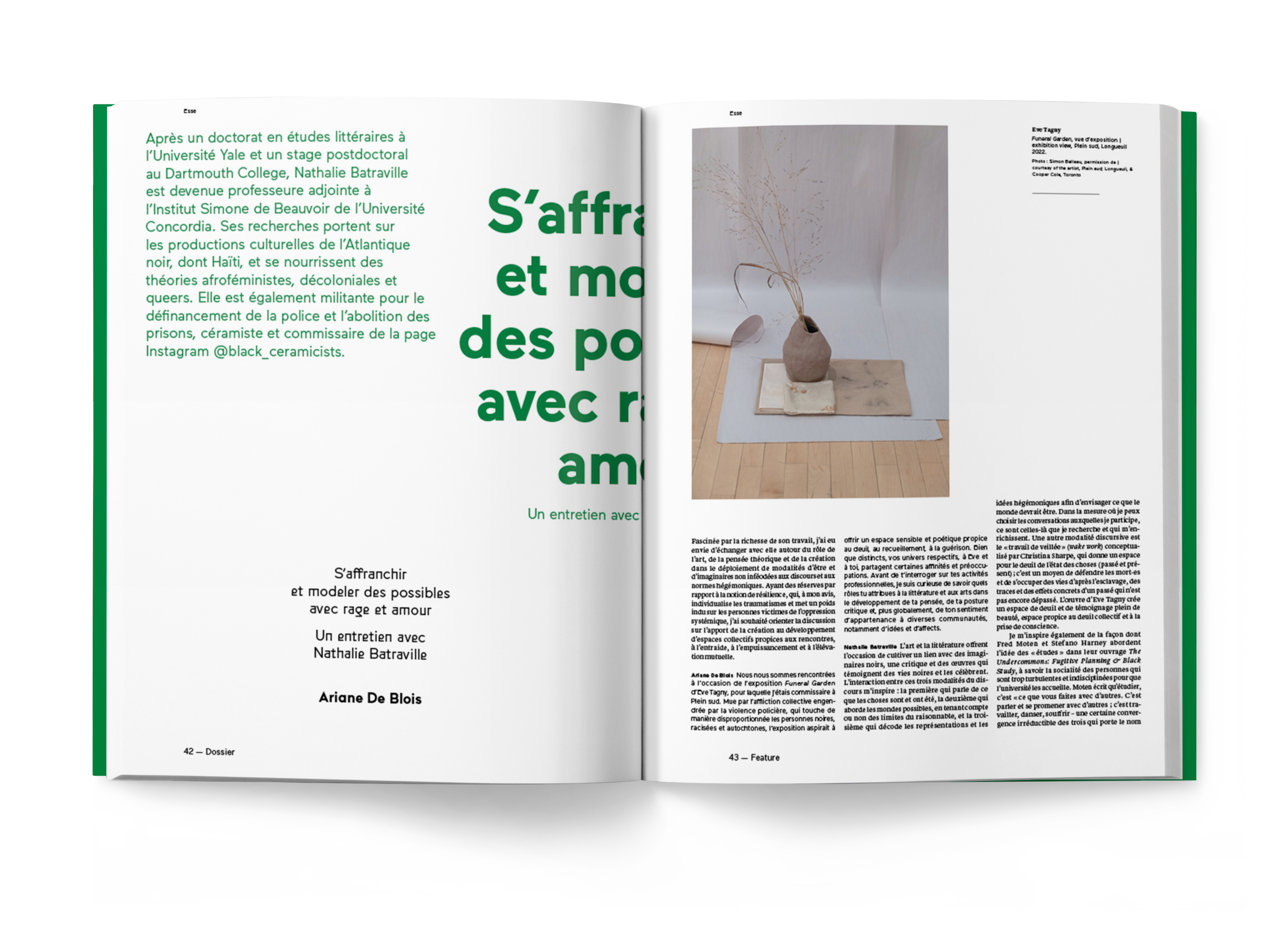
Batraville speaks to the intimacy among maker, material, and community in the ceramics studio: “Working with clay — touching and shaping clay — simultaneously mobilizes art, intimacy, and politics … Pottery is a particularly social practice involving several kinds of intimacy that are banal yet life altering, especially when grounded in community, in collective liberation. Capitalism, colonialism, and the carceral state do not physically isolate subjects just from each other, but also from ancestral practices used to connect with each other and with ourselves … Sitting and sharing and touching can create bonds that challenge logics of competition, exploitation, and extraction.”9 9 - Nathalie Batraville, quoted in Ariane De Blois, “Becoming Free and Modelling the Possible with Rage and Humour: An Interview with Nathalie Batraville,” Esse Arts + Opinions, no. 108 (Spring–Summer 2023), accessible online. Although Batraville is speaking specifically about Black life and Black study, her framework illuminates something broader about what creation, including handmade craft, can do in the face of systemic isolation of people and erasure of histories.
Craft reminds us that we are active participants in a world that precedes and exceeds us; we are enmeshed in a complex web of relationships with one another, the land, and our traditions. Recognizing that we are part of something bigger than ourselves offers us resources to learn from and dreams to motivate us, giving us a sense of purpose and belonging in an increasingly isolating society. In that sense, engaging with craft is as much about situating oneself in a collective society and history as it is about self-expression.
Materials and knowledge are rooted in place in local soils, climate, and the needs of the community. For example, I learned during my undergraduate research that when naturally dyeing textiles, the same species of plant can yield a different colour on wool yarn in Montréal than in rural Québec, depending on the pH of the soil in which the dye plant was harvested, where the wool-yielding animal grew, and the mineral contents of local water. The same is true of technique. To take one instance, kantha is a historical quilting technique from the Bengal region, made primarily by women for household purposes using running stitches. Even within this region and stitching technique, distinctions in the craft arise from the maker’s identity. Kantha quilts made by Muslim women feature geometric and abstract patterns, whereas quilts made by Hindu women favour pictorial storytelling.10 10 - Kalpana Sunder, “The Stories Hidden in the Ancient Indian Craft of Kantha,” BBC, October 22, 2022, accessible online. The crafted object, then, becomes a living archive and part of a collective memory that, to a knowledgeable eye and practised touch, tells the maker’s story, including the time and place the object was made.
It is important to acknowledge that, for many people, making is not a readily available option in a society in which time, money, space, and knowledge are unevenly distributed. If human and material relationships have been designed out of everyday life by systems of mass production and mass consumption, then making and mending become both a structural challenge and also an act of resistance.
We began by making everything by hand, in the company of others, connected to the materials, places, and people around us. Then we were told that convenience was progress, and we bought that idea. Convenience culture is so embedded in our lives now that making or mending can feel virtuous, whereas for previous generations who used things that broke, it was always a natural response. We continue to pay for that convenience with the loss of our autonomy and collective identity. Making has always been about the relationships we build in the process. Craft sustains community because it has always been rooted in the material knowledge and skills passed down from hand to hand across time and space. To return to making is to return to ourselves.
Links to the articles cited: Luanne Martineau Janice Esther Tulk Sarah Pearson Ariane De Blois
Khadija Aziz is a Pakistani-Canadian craft artist and educator based in Toronto. Her practice is rooted in textiles, a medium that carries erased histories of labour, migration, and cultural knowledge. She investigates transformation and memory, with a growing focus on how personal and cultural narratives migrate and shift across generations and geographies. Aziz holds an MFA from Concordia University and a BFA from OCAD University, both in textile art. She is currently an artist-in-residence at Harbourfront Centre’s Textile Studio.


