Privileging Non-Human Persistence

During her digital residency in partnership with Art Volt and Érudit, Olivia Vidmar explored the concept of “third nature.” Drawing on ideas from anthropology, art history, and conservation, the author analyzes how artists and theorists challenge anthropocentrism, prioritize horizontal relationships with living beings, and propose forms of care based on relinquishing control, loss, and what she calls the “non-human persistence.”
In her book The Mushroom at the End of the World: On the Possibility of Life in Capitalist Ruins, the anthropologist Anna Lowenhaupt Tsing offers the term “third nature” to describe where mycelium networks, known to flourish in hostile and seemingly nutrient-devoid environments, thrive. Third nature names entanglements between human intervention and non-human life that result in places or systems neither entirely uninterrupted by capitalist infrastructure (first nature) nor fully controlled by humans (second nature). Life in urban peripheries, abandoned industrial sites, and post-extraction landscapes exists in the liminality of third nature, or “what manages to live despite capitalism.”1 1 - Anna Lowenhaupt Tsing, The Mushroom at the End of the World: On the Possibility of Life in Capitalist Ruins (Princeton, NJ: Princeton University Press, 2015), viii. What roles can artists and curators play in these environments shaped by complex, anthropogenic histories where humans are no longer central?
During this residency, I combed through Esse and Érudit archives, searching for strategies utilized by artists and curators to grapple with such contexts. How do they attend to the assemblages of life forms, relationships, and ecologies that persist, adapt, or thrive in the ruins left by capitalist transformations? My questions are informed by a curatorial approach to ruinous or historical milieus that are vulnerable to entropy and open to non-human ecologies. Rather than resisting loss and prioritizing preservation, what the cultural geographer Caitlin DeSilvey calls “palliative curation” offers an alternate route for an intentional ending to presumed human dominance over them. In the gap between abandonment and attention, palliative curation embraces the breakdown of matter and proposes that care for these environments can be found in the relinquishment of control.2 2 - Caitlin DeSilvey, Curated Decay: Heritage beyond Saving (Minneapolis: University of Minnesota Press, 2017), 21. For example, in the case of a beloved, decommissioned lighthouse at risk of imminent loss due to coastal erosion, DeSilvey proposes a shift in perspective. If we understand the lighthouse as a process rather than as a static thing to be preserved, we may locate its persistence in how its matter becomes part of other physical, material, cultural, and social systems and processes—the last two conditions perhaps being the most enduring.3 3 - Caitlin DeSilvey, “Palliative Curation and Future Persistence: Life after Death,” in Cultural Heritage and the Future, ed. Cornelius Holtorf and Anders Högberg (London: Routledge, 2021), 225.


How do artists, authors, and curators navigate the gap that DeSilvey describes? How do they relinquish the pretense of humans at the centre while still exercising care for the perspectives and persistence of non-humans? This balance seems delicate, but I think there is potential for artists to reorient anthropocentric perspectives and propose generative practices for grappling with loss, change, and life in third-nature environments.
The art historian Amanda Boetzkes offers a helpful reminder to begin with: in art history, representations of the environment have often been couched in human superiority and control. The contemporary artists whom she discusses muddy this hierarchy. In her 2010 essay “Waste and the Sublime Landscape,” Boetzkes traces the aesthetic of the sublime, which, in early Western landscape tradition, “articulates a tension between a sense of being overwhelmed by nature on the one hand, and an equally potent drive to contain it on the other.”4 4 - Amanda Boetzkes, “Waste and the Sublime Landscape,” RACAR: Revue d’art Canadienne 35, no. 1 (2010): 22, accessible online. She argues that both Edward Burtynsky’s topographical photography of industrial wastescapes and Jérôme Fortin’s sculptural assemblages made of industrial garbage revive the sublime to subvert this paradigm. Here, the awesome quantity of waste and garbage produced by human activity substitutes for rolling hills or stormy waters. By paralleling these landscapes with the sublime, Boetzkes argues that both artists raise questions about “human-earth relations”—namely, that humans have erred in trying to define “nature” as something within our grasp. “In this way,” Boetzkes suggests, “the landscape of waste articulates the point at which human supremacy over the earth ends and a new contact with it might begin.”5 5 - Ibid., 23.

Shipbreaking #13, Chittagong, Bangladesh, 2000.
Photo: courtesy of the artist & Nicholas Metivier Gallery, Toronto
This idea is illustrated best through Fortin’s Seascapes (2001–03). Made from plastic bottles collected from the banks of the St. Lawrence River in Saint-Jean-Port-Joli, Québec, these pieces conjure the very environment from which the material was sourced—and underscore the ubiquity of water-bound plastic waste. By cutting the bottles into strips and adhering them to tondos in a composition akin to waves, with bottle caps popping up periodically, Fortin recalls glistening water. In sum, Boetzkes suggests that this denatured representation of water through garbage demonstrates the potential of the contemporary “sublime” wastescape. “If the hyperproduction of garbage is a symptom of the spread of ecotechnology that reinforces human dominion over the planet,” Boetzkes concludes, “then the sublime landscape of waste enacts the loosening of this suffocating agglomeration.”6 6 - Ibid., 31.
It is this “loosening” and shift away from what Boetzkes calls “constrictions of anthropocentric discourse” that I considered as I continued my reading. I thought about the work of the Métis anthropologist and researcher-artist Zoe Todd, who likewise looks to unsettle these discourses. Effective art of the Anthropocene must challenge human-centric and Eurocentric framings.
Todd illustrates how Euro-Western scholars, artists, and worldviews might learn from Indigenous materialism and relationality. Drawing from the analysis by art historians Jessica Horton and Janet Berlo of material (water, pollutants, and corn) and political engagement in the work of the Indigenous artists Rebecca Belmore and Jolene Rickard, Todd suggests that “material as bridge—between people and non-human agents—can allow a different understanding of the Anthropocene to emerge.”7 7 - Zoe Todd, “Indigenizing the Anthropocene,” in Art in the Anthropocene: Encounters Among Aesthetics, Politics, Environments and Epistemologies, ed. Heather Davis and Etienne Turpin (London: Open Humanities Press, 2015), 248. accessible online; Jessica L. Horton and Janet Catherine Berlo, “Beyond the Mirror,” Third Text 27, no. 1 (2013): 17, accessible online.
Esse 87: The Living proposes to address the living from a non-anthropocentric perspective. In this issue, Estelle Zhong’s essay “From Critical Art to an Art of Reconciliation: Cohabitation with Non-Human Animals” echoes Boetzkes’s criticism of human exceptionalism compounded by the traditional landscape genre. Zhong is hopeful that art might work to correct this in a lasting way; she draws from the ideas put forth by the evolutionary biologist Michael Rosenzweig’s “reconciliation ecology,” in which he proposes conditions of cohabitation for non-humans in highly anthropized landscapes. In the context of the American artist Fritz Haeg’s Animal Estates, Zhong questions how to make room for non-human animals in these landscapes.
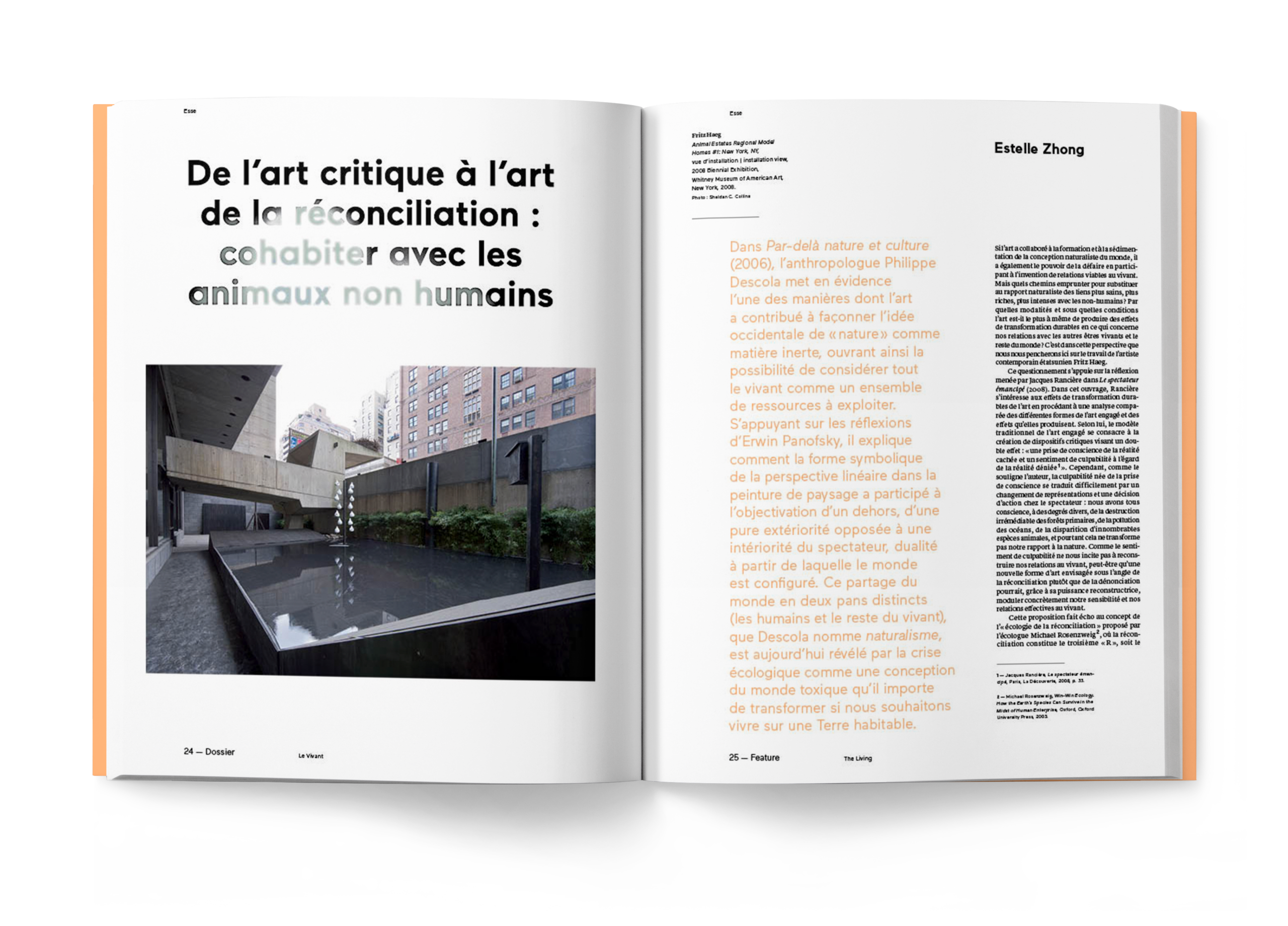
During the 2008 Whitney Biennial, Haeg constructed habitats for non-domesticated animals around New York City—including those that had left these lands centuries ago. Above the Whitney’s entrance, he installed a huge eagle’s nest; in another area, he created a lynx den. These “elegiac installations” for long-absent animals might evoke a sense of loss or deprivation for the viewer, knowing that the animal may never inhabit these dwellings in the urban landscape. Zhong locates the work’s success in the affective impact of loss and absence, in that it may “instil in us a sense of the value of an attentive cohabitation” with non-humans.8 8 - Estelle Zhong, “From Critical Art to an Art of Reconciliation: Cohabitation with Non-Human Animals,” Esse arts + opinions, no. 87 (2016): 28.
Through her practice of palliative curation, Desilvey identifies a parallel link between the emotional resonance of an entropic site and the human desire to preserve it. This can create a paradox when preservation efforts risk “embalming a living thing.”9 9 - DeSilvey, “Palliative Curation,” 227. Though New York is far from a landscape of decay or ruin, Haeg’s habitats act as reliquaries for a past ecological iteration that has been lost. Notably, Haeg collaborated with ethnologists and zoologists in creating these habitats, which were later relocated to a greener area to be inhabited as intended. More than a decade later, I wonder what life has found them. DeSilvey’s and Todd’s proposals for approaches that privilege relations with more-than-humans feel relevant here— outside of the work’s affective impact on humans, how can artists centre the agency and persistence of non-humans?

Animal Estates Regional Model Homes #1: New York, NY, installation view, 2008, Whitney Museum of American Art, New York, 2008.
Photo: Mark Barry
In her essay “Conversing with Ghosts of the Previously Tamed” (2019), published in Espace 121, the art historian Martina Caruso examines the privileging of non-anthropocentric perspectives and non-human agency in the video work of Christoph Keller, Corinne Silva, and Basma Alsharif. Caruso acknowledges an enigma for artists: although posthuman philosophies suggest a rejection of hierarchies among life on Earth, without tangible examples in the systems that govern our lives, artists may find it hard to represent such utopian thinking.10 10 - Martina Caruso, “Conversing with Ghosts of the Previously Tamed,” Espace, no. 121 (2019): 28. Without the established presence of this horizontality in existing polity, Caruso suggests that non-anthropocentric relationality can take an elusive, “ghostly form.” The artists in question attempt to represent this by obfuscating their own presence and yielding to the agency of the “previously tamed” (here, animals, as well as the camera). Keller’s video work Storni Morti (2018), for example, intersplices scenes of starlings in a cemetery in Rome with those of a bird conservationist speaking in a non-linear way. Keller references a recent, mysterious event of starlings dying and falling out of the sky; the conservationist explains that intervention here on the basis of human empathy risks warping our view of their ecosystem.11 11 - Ibid., 30. Caruso suggests that Keller’s presence is not detectable, as he de-emphasizes himself to privilege the interaction among the other actors: the starlings, the conservationist, and the camera.
In another work, Keller references the French philosopher Gilles Clément’s “third landscape” which Caruso defines as a “space that expresses neither power nor submission to power.”12 12 - Gilles Clément, Manifeste du Tiers paysage (Rennes: Éditions du commun, 2004), 4. In further probing Clément’s manifesto, I understand “third landscape”to encompass undecided, neglected fragments in an ecosystem (a forest, a lichen, a wasteland) where there is biodiversity in the absence of any human control. Like Tsing, Clément offers a framework for recognizing interconnectedness and impact across species. Caruso concludes that in the work of the artists she discusses, ghosts of the untamed are offered such a space, in which hierarchies of the Western capitalist system become blurred.
Andrea Williamson likewise discusses the potential for art to invite reconsideration of hierarchical systems in spaces at the threshold of neglect and control. In her essay “Pre-demolition Art as a Staging of Power-free Relations,” in Esse 80: Renovation (2014), Williamson proposes methods that artists and curators can use to attempt contraventions to dominant powers under capitalism. Her case study, Phantom Wing, took place in an old wing of King Edward School in Calgary, slated for demolition and redevelopment. Before the building was destroyed, a group of over thirty curators and artists staged an exhibition that included immersive installations and performances. Williamson discusses the dual potential of art in this context: artists’ interactions with the space have the potential to propose non-commodifiable uses and suggest alternate “power-free” futures; on the flipside, developers might benefit from the cultural capital that the artists’ interventions generate.
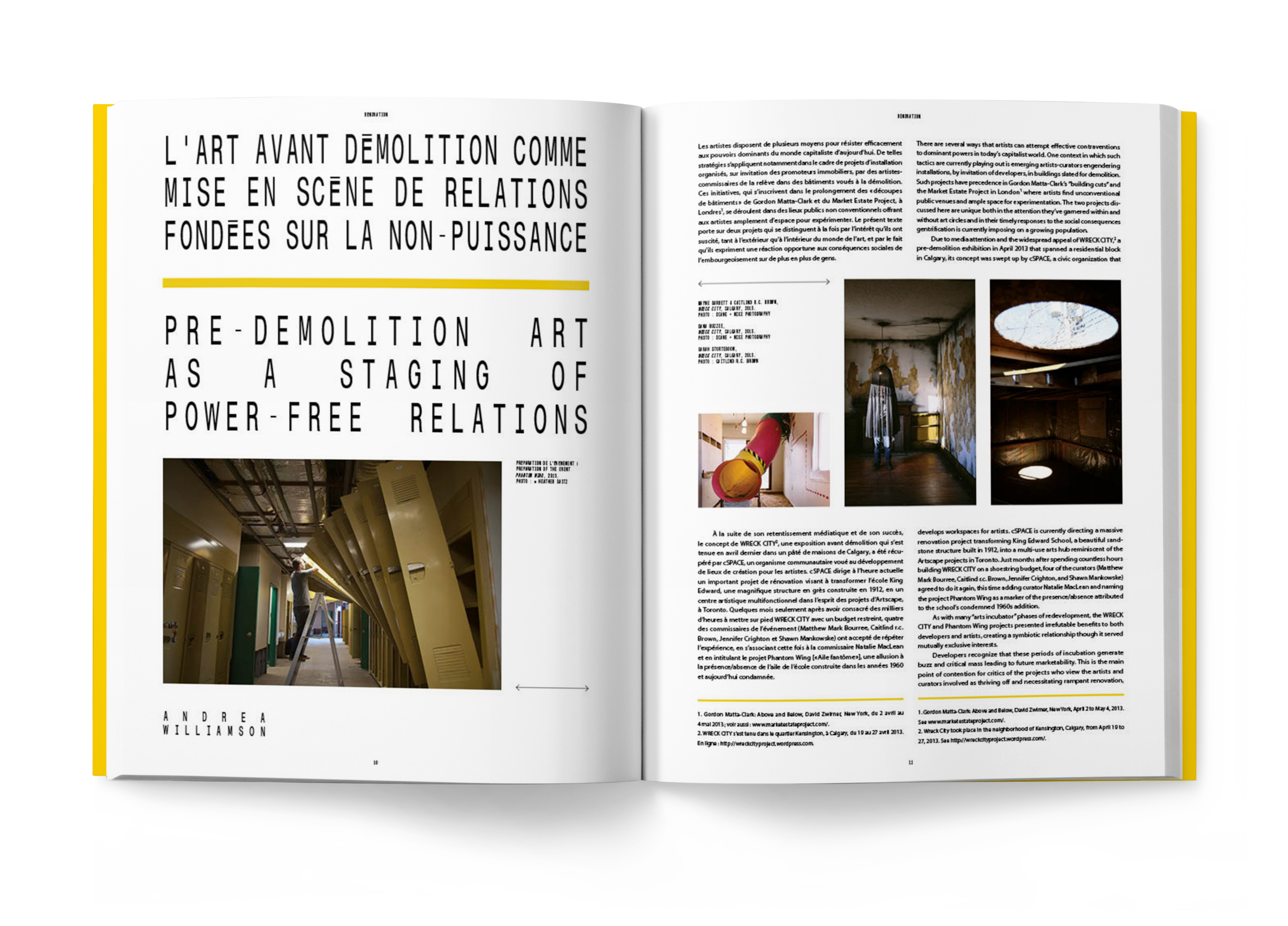
Following this prudent observation, Williamson argues that Phantom Wing ultimately opened “a critical space of questioning power as well as proposing relationships with the intangible, or that which cannot be codified and transmitted in terms of power.”13 13 - Andrea Williamson, “Pre-Demolition Art as a Staging of Power-free Relations,” Esse arts + opinions, no. 80 (2014): 16. Rather than reproduce existing hierarchies, art may recodify these relations. As Caruso emphasizes, we often lack societal and political structures to dismantle these hierarchies, necessitating creative interventions to imagine new relations that make room for non-human persistence.
As I conclude this time spent with the Esse and Érudit archives, Caruso’s and Williamson’s proposals to render horizontal relationships in third spaces tangible through creative practice feel poignant, as well as shared, in different ways, by the artists, authors, and curators whom I’ve encountered during this residency. Tsing reminds us that progress narratives have often been blinding and that to even recognize third nature, we must “evade assumptions that the future is that singular direction ahead.”14 14 - Tsing, The Mushroom at the End of the World, viii. Cumulatively, these texts present strategies for evading those assumptions; rather than asserting authority, the authors attempt to acknowledge the ruins of anthropocentrism with care and attentiveness for the perspectives and persistence of non-humans. I still think this balance is a delicate one, but I am left hopeful that artists can reorient our perception of meaning in these environments, loosening our grip on the pretense of humans at the centre.
Links to the articles cited: Amanda Boetzkes Estelle Zhong Martina Caruso Andrea Williamson
Olivia Vidmar is an artist, writer and emerging curator based in Tiohtiá:ke/Mooniyang/Montréal. She holds a BFA from Concordia University and an MA in Art History, where her thesis research focused on the relationships between public art and urban renewal in post-industrial neighbourhoods. Olivia’s research practice is informed by feminist methodologies and embodied, situated approaches to understanding spatial histories. She recently completed a collaborative curatorial residency at La Centrale galerie Powerhouse and her writing has been published in Esse arts + opinions.


